Over Time
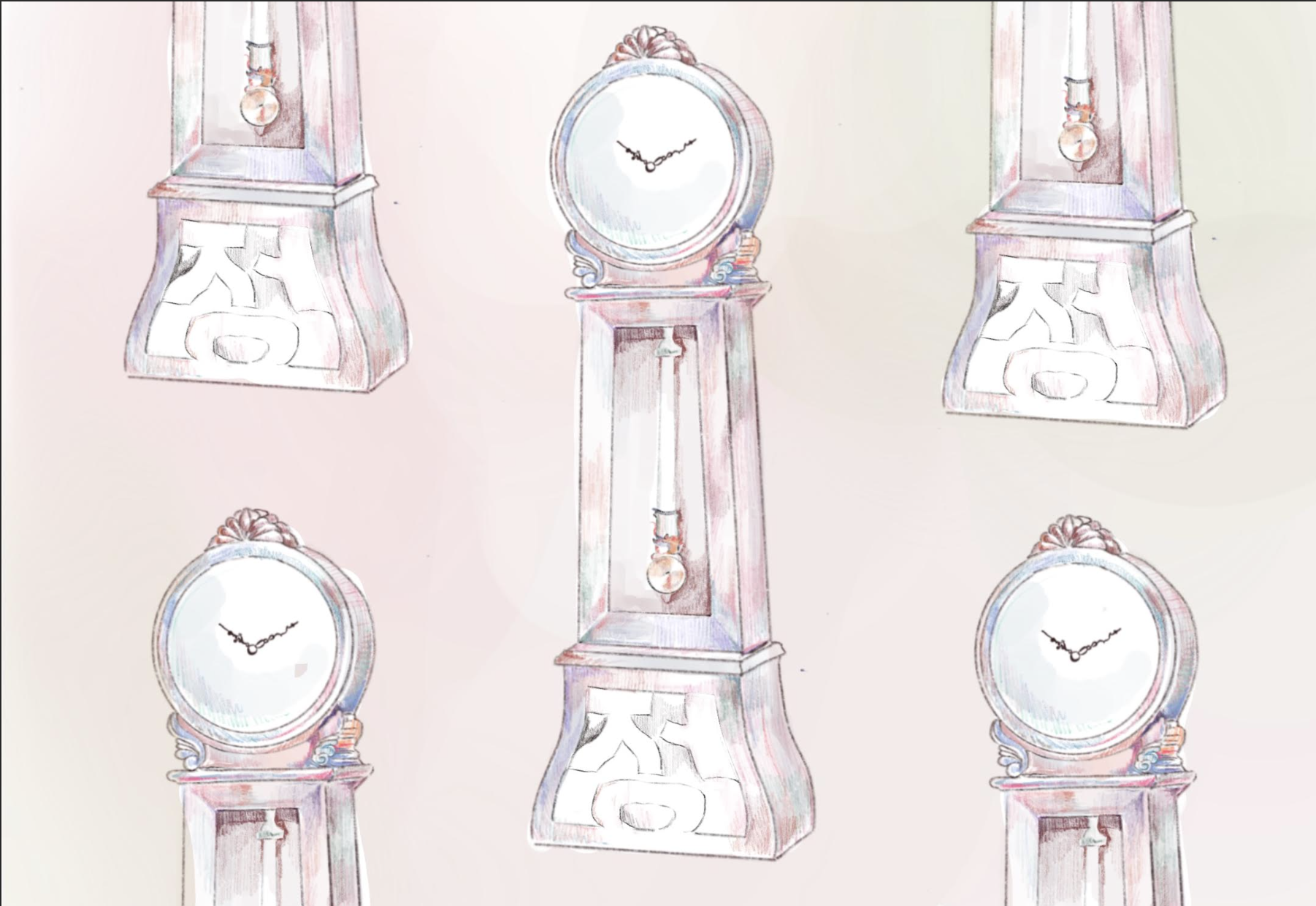
Graphic By: Victoria Li
Joanne Park
15 10 2025
15 10 2025
My mom still keeps the grandfather wall clock that’s been a part of our living room since I don’t know how long. The hazy limitations of my memory make sense, though, as I had recently found out it had been a wedding gift that immigrated with her from South Korea to America.
The clock is older than me. So, it also makes sense that it doesn’t work anymore.
It’s bittersweet almost, as a physical, literal representation of time passing, of something worn away with use. How many times must the pendulum have swung back and forth in those twenty six years, housed in our suburban American home? And now, it doesn’t anymore, a heartbeat at rest.
My mom seemed unconcerned with the poetics, though, never having been a materialistic or even particularly sentimental person. It’s not too important how it traveled with her to America, or even that it had been a wedding gift, she once mentioned. Still, she keeps the clock anyway.
“Well, it’s useless,” she said, “but I have jeong for it, now.”
Jeong (정) permeates Korean culture. It’s the pillar of relationships, of hospitality, of the general understanding of how we interact with objects, places, people. With its origin from the Chinese character 情, it’s even a part of common Korean words like in friendship (woojeong) and affection (aejeong). Somehow, it’s love, sentiment, and attachment, but also singularly none of those at the same time.
I have jeong for places, like my childhood bedroom, or the cramped freshman year dorm that I spent 10 months in with two other roommates. There’s jeong for things, like my mom and her clock, and for people too. My halmeoni—my grandmother—once told me in her distinct Busan dialect with a wry laugh that could’ve been joking but also not, “You think I’m still with your harabeoji because I love him? No, we have jeong for each other now, that’s what happened.”
It’s not quite just love or attachment, if either of those things could be just anything. Jeong feels like an extra layer of connection, of settled-in care and affection, with a wrench thrown into the three-dimensional as it brings in the flow of time. It’s disheartening to part ways with someone you recently befriended because jeong had only just started setting in. My shoebox of a freshman dorm sometimes felt stressful when I was in it, but I was still sad to leave it by the end, with all the people and the memories permeated within its walls. Jeong. It’s not necessarily a feeling, like one might consider fondness, but it’s also not just simply something else.
Jeong is easier to explain as what it’s not rather than what it is, even in Korean, and more so in English. It feels like I’m chasing ghosts. But if I had to put it into words, it’s an understanding between people, the connection, more than an emotion itself. Jeong can’t be detached from anything. It brings us all together.
Maybe my mom really does love that grandfather wall clock, but to her, it’s also just a clock. She glances over at the oven’s blinking digital numbers when she wants to know the time now, just a slight adjustment to her routine. But with the circumstances, of time, of immigrant life, there was jeong.
I find myself seeking comfort in the concept of jeong. There’s an intrinsic humanity to how it connects me to everything, everyone I care about. There’s love with jeong, but there’s also history, however short-lived, and thereby an ongoing present and future.
With jeong, I look forward and onward, but I also look back. It’s all connected.
The clock is older than me. So, it also makes sense that it doesn’t work anymore.
It’s bittersweet almost, as a physical, literal representation of time passing, of something worn away with use. How many times must the pendulum have swung back and forth in those twenty six years, housed in our suburban American home? And now, it doesn’t anymore, a heartbeat at rest.
My mom seemed unconcerned with the poetics, though, never having been a materialistic or even particularly sentimental person. It’s not too important how it traveled with her to America, or even that it had been a wedding gift, she once mentioned. Still, she keeps the clock anyway.
“Well, it’s useless,” she said, “but I have jeong for it, now.”
Jeong (정) permeates Korean culture. It’s the pillar of relationships, of hospitality, of the general understanding of how we interact with objects, places, people. With its origin from the Chinese character 情, it’s even a part of common Korean words like in friendship (woojeong) and affection (aejeong). Somehow, it’s love, sentiment, and attachment, but also singularly none of those at the same time.
I have jeong for places, like my childhood bedroom, or the cramped freshman year dorm that I spent 10 months in with two other roommates. There’s jeong for things, like my mom and her clock, and for people too. My halmeoni—my grandmother—once told me in her distinct Busan dialect with a wry laugh that could’ve been joking but also not, “You think I’m still with your harabeoji because I love him? No, we have jeong for each other now, that’s what happened.”
It’s not quite just love or attachment, if either of those things could be just anything. Jeong feels like an extra layer of connection, of settled-in care and affection, with a wrench thrown into the three-dimensional as it brings in the flow of time. It’s disheartening to part ways with someone you recently befriended because jeong had only just started setting in. My shoebox of a freshman dorm sometimes felt stressful when I was in it, but I was still sad to leave it by the end, with all the people and the memories permeated within its walls. Jeong. It’s not necessarily a feeling, like one might consider fondness, but it’s also not just simply something else.
Jeong is easier to explain as what it’s not rather than what it is, even in Korean, and more so in English. It feels like I’m chasing ghosts. But if I had to put it into words, it’s an understanding between people, the connection, more than an emotion itself. Jeong can’t be detached from anything. It brings us all together.
Maybe my mom really does love that grandfather wall clock, but to her, it’s also just a clock. She glances over at the oven’s blinking digital numbers when she wants to know the time now, just a slight adjustment to her routine. But with the circumstances, of time, of immigrant life, there was jeong.
I find myself seeking comfort in the concept of jeong. There’s an intrinsic humanity to how it connects me to everything, everyone I care about. There’s love with jeong, but there’s also history, however short-lived, and thereby an ongoing present and future.
With jeong, I look forward and onward, but I also look back. It’s all connected.