Never Will There Be A Spring
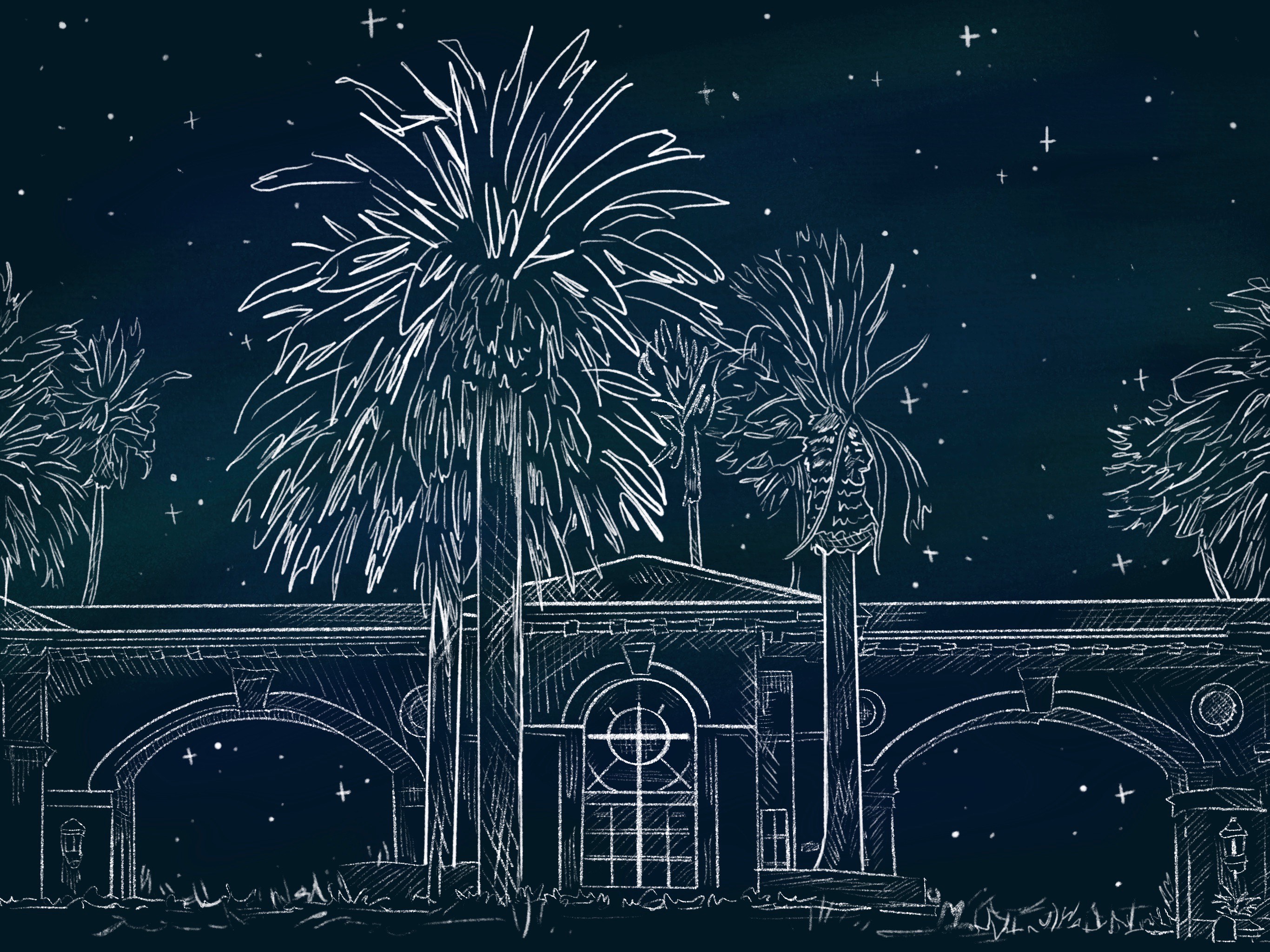
Graphic By: Lea Karain
Sophia Dorian
25 11 2025
25 11 2025
I am from Southern California in a town founded by Edgar Rice Burroughs, the guy who wrote Tarzan. The place I live in is creatively named “Tarzana.” Despite the best efforts from the Tarzana community center folk to help the city live up to its namesake and emulate the extravagant visual diversity of a jungle, it remains difficult for anyone to pinpoint a single exotic element of a town in the heart of the Los Angeles Valley. Unless a jungle consists of telephone wires and detritus made up of cigarette butts and dust, I would also hesitate to depict Tarzana as having “jungle essence” of any capacity. If Tarzan was set in my city, our titular protagonist would have grown up raised by bobcats, retreating to the sienna hills at the sight of an oncoming Toyota Camry.
As a child, I was always desperate to be outside, to climb the hill behind my house and get rashes on my shins from the mysterious semi-poisonous plants that grew there. There were an abundance of tree stumps and branches to swing from and sit on, and I’d choose to lodge myself uncomfortably in the crook of a tree to read Diary of a Wimpy Kid for the sake of being in the great outdoors. I would think about how lucky I was to live in a house where I could take two steps outside and immediately be in the “wilderness,” where I could fall asleep at night dreaming I was surrounded by pines with a cool breeze at my feet as I strained to disregard the whistles of cars driving past my window.
My favorite part about the street I lived on was that every night and early morning, there would be coyotes who bound down the hills where they usually remained, travelling in duos as they searched the road for rabbits or perhaps the occasional stray cat. I always characterized these coyotes as endearing, coming down into the human world to leap around with their friends in the moonlight. When I heard them howl, I was safe and cozy in my bed, happily imagining them having a ball prancing around with one another on the soft Tarzana asphalt as they sang their favorite song.
I pictured them retreating to their dens every morning, in a far away place surrounded by fall foliage and untouched by humanity. They were on the external edge of my world, and they existed in a separate, un-infiltrated, “wilderness.” I had no idea that on the backside of the Tarzana hills, there were no woods or forest in which all the domestic, friendly animals coagulated every day. I had forgotten that it wasn’t moonlight that illuminated their nighttime escapades, but street lamps that glared down on them, telling them that “this place is no longer yours.” I didn’t know that if what was wild was on the exterior corner of an anthropocentric society, we as humans had extended past and infiltrated that domain long ago.
Coyotes have been present in the Los Angeles region for thousands of years, and, of the canine predators that used to call it home, are the only ones that remain. Our human society, particularly Los Angeles, is way past the novelty of urbanization and industrialization, and no longer reflects any kind of balance between the “wild” that came before men like Mr. Burroughs who chose to twist their legacy like a knife into the dirt. There is no longer the land that remained where coyotes could afford to be territorial, when they were considered not a quirk of the urban world but an irremovable element of their ecological domains. The mere right that a Los Angelino homeowner retains to call a trapper to forcefully remove the coyotes nesting in their backyard makes that fact undeniably clear.
Compared to the past, when humans had not yet completely decimated the natural landscape, coyotes now have to travel much farther to cover a far more expansive area of urban land to maintain their survival, traipsing across what I can only assume they perceive as an apocalyptic image of desolation just to find a place to sleep. To exacerbate the difficulty of their labor, residents who interact with their natural surroundings with the care and tenderness of a toddler handling a bowl of fruit loops are quick to dial animal protective services when faced with the horrifying threat of a coyote cub leaping across their porch to join his mother under a wire fence. These valley coyotes have been reportedly getting more aggressive – undoubtedly frustrated with the quickening loss of familiarity towards what was once their homes, watching helplessly as one of few plots of empty land is turned into yet another tan, Spanish-style home for a young Los Angeles couple obsessed with the Reseda hills.
People who would define themselves as “environmentalists” or “nature-lovers” are deluding themselves if they believe that their “love” for the natural world extends beyond everything that they have come to find normal – that the routine activity of a human in the modern world is not inherently disruptive to the ecological cycles of our planet. It is impossible to claim any kind of true devotion to environmentalism if you have ever turned on a flashlight in the pitch dark of the night, driven your car through an unbeaten path, or pointed out the presence of a coyote family in your backyard to your siblings and friends as a kind of native attraction, scaring them away from the rabbit carcass you later find and rebuke as a disappointingly primitive habit of these animals who you are shocked have not yet become accustomed to your presence. There is no possible way to leave the natural world alone if you are residing in it as a modern human being, and in turn, there will never be a spring, where the coyotes and the creatures on the hill can weave between flowers that have not already been trampled under the sole of the human race.
Driving up the road to my home at the top of a hill, freshly plucked from the airport and ready to leap into my childhood bed as the pink and orange of the sky folds away to reveal navy blue, I can still hear the faint yips coming from the pockets of blackened shadow in the street. There are no coyotes who have remained to sing at night, only to cry and weep with no soft ground to rest their heads, hanging low with exhaustion and defeat. On the way up, a cub is laying lifeless on the side of the road, her wailing mother crouching down beside her when the headlights of our car slam her in the eyes, cutting her mourning short as she leaps up the hill. As I watch her make her escape, I wonder if the place where her child is waiting for her now is full of snowy rabbits and tall coarse grasses and canopies of shady trees. I wonder if in running to safety, her mother was keeping herself from being injured so that, when she sees her child again, they can play together in apple groves that are illuminated by real moonlight. I imagine that there would be no house for me in this second world of theirs, and that there would be flowers sprouting from where there are now the concrete steps I climb to walk up to my front door. I listen to her screams emanating from within the splintered shrubbery of the hill, and can do nothing but leave her grief in the stifling lamplight as I enter my human home, closing the door to that fragment of the wilderness behind me.
As a child, I was always desperate to be outside, to climb the hill behind my house and get rashes on my shins from the mysterious semi-poisonous plants that grew there. There were an abundance of tree stumps and branches to swing from and sit on, and I’d choose to lodge myself uncomfortably in the crook of a tree to read Diary of a Wimpy Kid for the sake of being in the great outdoors. I would think about how lucky I was to live in a house where I could take two steps outside and immediately be in the “wilderness,” where I could fall asleep at night dreaming I was surrounded by pines with a cool breeze at my feet as I strained to disregard the whistles of cars driving past my window.
My favorite part about the street I lived on was that every night and early morning, there would be coyotes who bound down the hills where they usually remained, travelling in duos as they searched the road for rabbits or perhaps the occasional stray cat. I always characterized these coyotes as endearing, coming down into the human world to leap around with their friends in the moonlight. When I heard them howl, I was safe and cozy in my bed, happily imagining them having a ball prancing around with one another on the soft Tarzana asphalt as they sang their favorite song.
I pictured them retreating to their dens every morning, in a far away place surrounded by fall foliage and untouched by humanity. They were on the external edge of my world, and they existed in a separate, un-infiltrated, “wilderness.” I had no idea that on the backside of the Tarzana hills, there were no woods or forest in which all the domestic, friendly animals coagulated every day. I had forgotten that it wasn’t moonlight that illuminated their nighttime escapades, but street lamps that glared down on them, telling them that “this place is no longer yours.” I didn’t know that if what was wild was on the exterior corner of an anthropocentric society, we as humans had extended past and infiltrated that domain long ago.
Coyotes have been present in the Los Angeles region for thousands of years, and, of the canine predators that used to call it home, are the only ones that remain. Our human society, particularly Los Angeles, is way past the novelty of urbanization and industrialization, and no longer reflects any kind of balance between the “wild” that came before men like Mr. Burroughs who chose to twist their legacy like a knife into the dirt. There is no longer the land that remained where coyotes could afford to be territorial, when they were considered not a quirk of the urban world but an irremovable element of their ecological domains. The mere right that a Los Angelino homeowner retains to call a trapper to forcefully remove the coyotes nesting in their backyard makes that fact undeniably clear.
Compared to the past, when humans had not yet completely decimated the natural landscape, coyotes now have to travel much farther to cover a far more expansive area of urban land to maintain their survival, traipsing across what I can only assume they perceive as an apocalyptic image of desolation just to find a place to sleep. To exacerbate the difficulty of their labor, residents who interact with their natural surroundings with the care and tenderness of a toddler handling a bowl of fruit loops are quick to dial animal protective services when faced with the horrifying threat of a coyote cub leaping across their porch to join his mother under a wire fence. These valley coyotes have been reportedly getting more aggressive – undoubtedly frustrated with the quickening loss of familiarity towards what was once their homes, watching helplessly as one of few plots of empty land is turned into yet another tan, Spanish-style home for a young Los Angeles couple obsessed with the Reseda hills.
People who would define themselves as “environmentalists” or “nature-lovers” are deluding themselves if they believe that their “love” for the natural world extends beyond everything that they have come to find normal – that the routine activity of a human in the modern world is not inherently disruptive to the ecological cycles of our planet. It is impossible to claim any kind of true devotion to environmentalism if you have ever turned on a flashlight in the pitch dark of the night, driven your car through an unbeaten path, or pointed out the presence of a coyote family in your backyard to your siblings and friends as a kind of native attraction, scaring them away from the rabbit carcass you later find and rebuke as a disappointingly primitive habit of these animals who you are shocked have not yet become accustomed to your presence. There is no possible way to leave the natural world alone if you are residing in it as a modern human being, and in turn, there will never be a spring, where the coyotes and the creatures on the hill can weave between flowers that have not already been trampled under the sole of the human race.
Driving up the road to my home at the top of a hill, freshly plucked from the airport and ready to leap into my childhood bed as the pink and orange of the sky folds away to reveal navy blue, I can still hear the faint yips coming from the pockets of blackened shadow in the street. There are no coyotes who have remained to sing at night, only to cry and weep with no soft ground to rest their heads, hanging low with exhaustion and defeat. On the way up, a cub is laying lifeless on the side of the road, her wailing mother crouching down beside her when the headlights of our car slam her in the eyes, cutting her mourning short as she leaps up the hill. As I watch her make her escape, I wonder if the place where her child is waiting for her now is full of snowy rabbits and tall coarse grasses and canopies of shady trees. I wonder if in running to safety, her mother was keeping herself from being injured so that, when she sees her child again, they can play together in apple groves that are illuminated by real moonlight. I imagine that there would be no house for me in this second world of theirs, and that there would be flowers sprouting from where there are now the concrete steps I climb to walk up to my front door. I listen to her screams emanating from within the splintered shrubbery of the hill, and can do nothing but leave her grief in the stifling lamplight as I enter my human home, closing the door to that fragment of the wilderness behind me.